
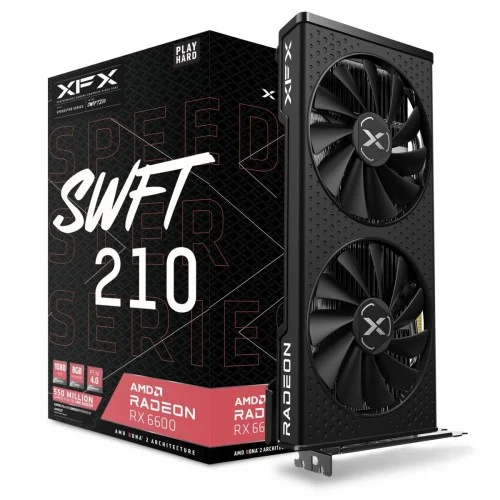
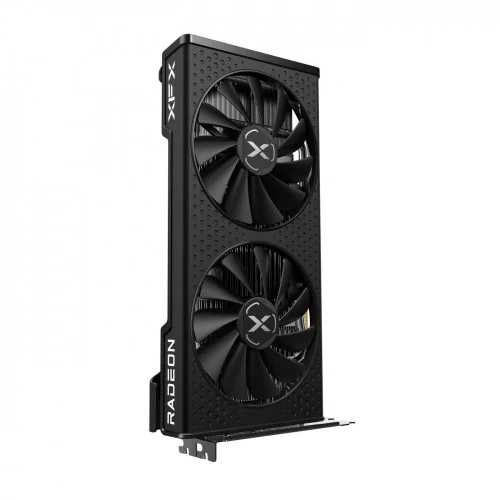
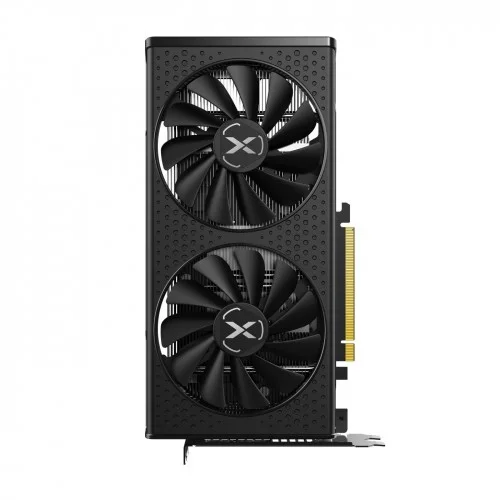
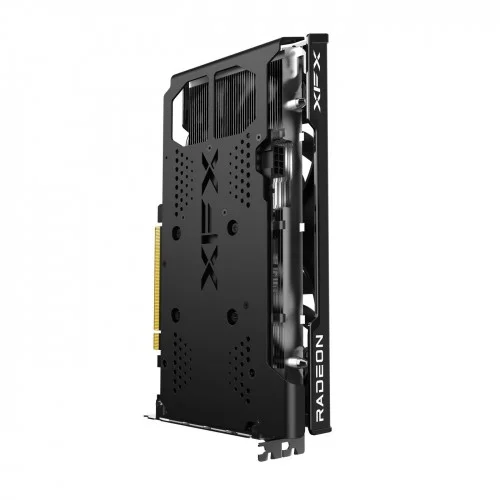
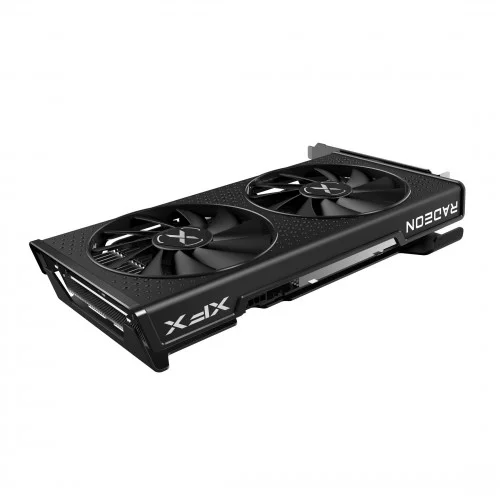
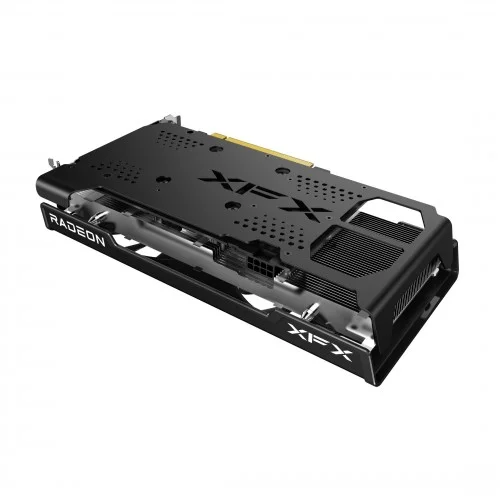
XFX Speedster SWFT 210 Radeon RX 6600 Core 8GB GDDR6 Gaming Graphics Card
Out Of Stock


XFX Speedster SWFT 210 Radeon RX 6600 Core 8GB GDDR6 Gaming Graphics Card
- Stock: Out Of Stock
- Model: XFX Speedster SWFT 210 RX 6600
- Product id: 22791
- MPN: RX-66XL8LFDQ
- Game Clock: Up to 2044 Mhz
- Boost Clock: Up to 2491 Mhz
- Memory Clock Speed: 14 Gbps
- AMD RDNA 2 architecture
Quick Compare
| Product Details | ||||
| Product | XFX Speedster SWFT 210 Radeon RX 6600 Core 8GB GDDR6 Gaming Graphics Card | Gigabyte GT 710 2GB DDR3 Graphics Card | OCPC GeForce GT 730 4GB DDR3 Graphics Card | MSI GeForce GT 730 4GB DDR3 Graphics Card |
| Image |  |
 |
 |
 |
| Price | |
|
|
|
| Model | XFX Speedster SWFT 210 RX 6600 | GV-N710D3-2GL | GT 730 | GeForce GT 730 |
| Brand | XFX | GIGABYTE | OCPC | MSI |
| Availability | Out Of Stock | In Stock | In Stock | In Stock |
| Rating | Based on 0 reviews. |
Based on 0 reviews. |
Based on 2 reviews. |
Based on 0 reviews. |
| Summary | XFX Speedster SWFT 210 Radeon RX 6600 Core 8GB GDDR6 Gaming Graphics Card Based On The RDNA 2 Architecture And Designed To Handle The Graphical Demands Of Full HD 1080p Gaming, The XFX Speedster SWFT 210 RX 6600 SWFT Gaming Graphics Card Provides An Immersive Gaming Experience With Your PC Games. The GPU Features 8GB Of GDDR6 VRAM And A 128-Bit Memory Interface, Offering Improved Performance And Power Efficiency Over The Previous RDNA-Based Generation. The Front Panel Of The Card Features A Variety Of Outputs, Such As DisplayPort 1.4 And HDMI 2.1. HDMI 2.1 Supports Up To 48 Gb/S Bandwidth And A Range Of Higher Resolutions And Refresh Rates, Including 8K @ 60 Fps, 4K @ 120 Fps, And Even Up To 10K. The XFX Speedster SWFT 210 RX 6600 Supports APIs Such As DirectX 12 Ultimate And OpenGL. These APIs Can Take Advantage Of The GPU's 2048 Stream Processors To Accelerate Parallel Computing Tasks, Taking Some Of The Processing Load Off Of The CPU. For Cooling, XFX Implemented A Dual Fan Cooler. DirectX 12 Ultimate DirectX12 Ultimate Gives Game Developers The Power To Deliver Immersive Visuals With Real-Time DirectX Raytracing (DXR), Variable Rate Shading (VRS), Mesh Shaders, And Sampler Feedback, Taking Games To The Next Level. AMD FidelityFX AMD FidelityFX Is An Open-Source Image-Quality Toolkit Comprising Of Seven Different Solutions Available For Game Developers To Implement Into Their Games That Are Optimized For AMD RDNA And RDNA 2 Architectures. AMD Radeon Image Sharpening Restores Clarity To In-Game Images That Have Been Softened By Other Post-Process Effects. RIS Combines With GPU Upscaling To Provide Sharp Visuals At Fluid Frame Rates On Very High-Resolution Displays, And Works Across DirectX 9, 12, And Vulkan Titles. AMD FreeSync 2 Technology Reduce Screen Tearing With AMD's FreeSync 2 Technology. FreeSync 2 Enables The Monitor To Dynamically Adjust Its Refresh Rate To The Frame Rate Being Output By The Graphics Card, Thereby Greatly Reducing Screen Tearing, Stuttering, And Other Artifacts. Radeon Anti-Lag Optimized For ESports, Radeon Anti-Lag Improves Competitiveness By Decreasing Input-To-Display Response Times By Up To 31 Percent, Delivering An Experience Similar To Higher Frame Rates. AMD Radeon Boost AMD Radeon Boost Dynamically Lowers Resolution Of The Entire Frame When Fast On-Screen Character Motion Is Detected Via User Input, Allowing For Higher FPS With Little Impact To Quality. XFX Speedster SWFT 210 Radeon RX 6600 Core 8GB GDDR6 Gaming Review If you want a GPU that can more easily make the jump from high-detail 1080p to 1440p play, cards based on AMD's Radeon RX 6600 XT or Nvidia's GeForce RTX 3060 Ti make better financial sense (mind you, in a time when there's little of that to be found in the third-party card market). That said, if you're fond of older game titles, AMD's drivers remain a core shortfall for the RX 6600 and its XT-badged bigger sibling. Gamers who play a lot of legacy titles that use older versions of Microsoft DirectX should consider competing Nvidia options instead...if they can find them. Looking at current-generation GPUs, the Radeon RX 6600's key competitor is clearly the GeForce RTX 3060. Each has its own strengths. Between the two, the Radeon RX 6600 wins outright when it comes to power draw. As a result, those on the hunt for a lower-power, smaller-footprint card won't be disappointed in what the XFX card seen here has to offer. The XFX Speedster SWFT 210 RX 6600 card we have in hand is one of a host of third-party designs based on AMD's Radeon RX 6600 GPU; AMD is not offering an official reference version or house-brand card as Nvidia often does. Like other RX 6000 series GPUs, the Radeon RX 6600 is built on the company's RDNA 2 architecture and features TSMC's 7nm lithography on a 237-square-millimeter "Navi 23 XT" die. XFX Speedster SWFT 210 RX 6600 dual-slot, dual-fan XFX Speedster SWFT RX 6600 is 10.1 inches long, which is larger than many 1080p gamers might like. However, our test card is just one of many different styles (including single-fan options) that will be available when the RX 6600 goes on sale today. AMD has published a reference spec for this card, which the 8GB XFX Speedster SWFT 210 matches exactly, though as mentioned the chipmaker won't be producing any cards of its own on this run. To pick up the slack, most of the regular third-party vendors have announced incoming versions, though what available stock will look like at launch we'll have to see. The XFX Speedster SWFT 210 RX 6600 sports a boost clock a little less than 100MHz below the RX 6600 XT's and slightly fewer active stream processors, but other than that (and the oddly specific power requirements) the two cards share specs up and down the line. Speaking of that 132-watt power requirement, it's quite a bit lower than Nvidia's 170-watt baseline for the GeForce RTX 3060—22% lower, to be exact. This is a considerable margin, and for users trying to build a low-power, small-form-factor 1080p gaming machine (a popular build type for many gamers) arguably gives the Radeon RX 6600 its strongest advantage over Nvidia's GeForce RTX 3060. As for ports, the back of our XFX card contains the same standard lineup we've seen on most GPUs lining (or, rather, widely spaced on) the shelves these days: three DisplayPort 1.4b outputs, one HDMI 2.1 port, and no VirtualLink. PC Labs ran the XFX Speedster SWFT 210 through a series of DirectX 11- and 12-based synthetic and real-world benchmarks. Our test rig, used for all cards in the charts below, is based on an Intel Core i9-10900K processor and employs a PCI Express 3.0, not 4.0, motherboard (an Asus ROG Maximus XII Hero Wi-Fi(Opens in a new window)). It's equipped with 16GB of G.Skill DDR4 memory and a solid-state boot drive. Given our tests with the Core i9-10900K and recent Ryzen 9 CPUs, this platform is the best reasonable configuration at the moment to take the CPU out of the equation for frame rates. (Read more about how we test graphics cards.) For our testing, we focused some of the effort on the Speedster's esports aspect with games like Counter-Strike: Global Offensive (CS:GO) and Rainbow Six Siege. We also ran the card through the rest of our standard benchmark regimen, which tests a GPU's abilities to handle AAA games at the highest possible quality settings, as well as how it rides during synthetic benchmarks that stress the card in a variety of ways. Almost every test we run (aside from the esports titles) is done at the highest possible visual quality preset or settings. If you have a higher-hertz gaming monitor and are worried your card might not make the frame-rate grade, it could still be possible with a combination of lower settings. Not only that, but some of these titles (including Death Stranding, Shadow of the Tomb Raider, and F1 2020) have both DLSS and FidelityFX CAS with Upscaling integrated directly into the game. This can yield performance boosts of up to 40%, depending on the setting and the card you're playing with. (See our guide to these technologies, Sharpen & Speed Up Your PC Games: Testing AMD's FSR, Nvidia's DLSS 2.2 & More, for more.) And so, onward to our test results. Note: If you want to narrow down the results below to a specific resolution (i.e., the resolution of the monitor you plan to use), click the other two resolution dots in the chart legends below to suppress them and see a single set of results. Our list of AAA titles includes a mix of recent games as well as some older but still reliable pillars of the benchmarker's toolkit like Shadow of the Tomb Raider and Far Cry 5. Synthetic benchmarks can be good predictors of real-world gaming performance. In UL's 3DMark, the circa-2013 Fire Strike Ultra is still a go-to approximation of the load levied by mainstream 4K gaming. We're looking only at the test's Graphics Subscore, not the Overall Score, to isolate the card's performance. Meanwhile, we also ran 3DMark's Time Spy Extreme, which is a good test of how well a card will do specifically in DirectX 12 games at 4K resolution. 3DMark's Port Royal, until recently run only on GeForce RTX cards, measures how well a GPU handles ray-tracing tasks (thus the absent bars for most of the AMD Radeon cards). Also here are a pair of GPU-acceleration tests (Furmark and LuxMark); more details on those at the "how we test" link above. Specifications Graphics Card Memory Size 8 GB Memory Type GDDR6 Core Clock Base Clock Up To: 1626 MHz Game Clock Up To: 2044 MHz Boost Clock Up To: 2491MHz Memory Bandwidth (GB/Sec) 48 Gb/S Memory Clock 14 Gbps Stream Processors 1792 Card Size Card Dimension : 24.1 X 13.1 X 4.1 Cm Card Dimension : 9.49 X 5.16 X 1.61 Inch Memory Bus (Bit) 128 Bit Power Consumption Minimum Power Supply Requirement: 550 Watt XFX Recommended Power Supply: XFX 650W PSU Resolution AMD Virtual Super Resolution (VSR) Interface (PCI Express) 3x DisplayPort: 1.4 With DSC 1x HDMI: 2.1 VRR And FRL Power Connector (Pin) 1x PCI-E 8 Pin Connections DirectX 12 Ports DisplayPort: 1.4 With DSC HDMI™: 2.1 VRR And FRL Output : Display Port 3 Output: HDMI 1 Multi Display AMD Eyefinity Multi-Display Technology OpenGL 4.5 Warranty 2 Years .. | Gigabyte GT 710 2GBGigabyte GT 710 2GB DDR3 Graphics Card Gigabyte GT 710 2GB DDR3 Graphics Card Powered by NVIDIA GeForce GT 710 GPU Integrated with the first 2048MB DDR3 memory and 64-bit memory interface Core Clock: 954MHz Features Dual-link DVI-D / D-Sub / HDMI Support PCI Express 2.0 x8 bus interface Recommended system power supply requirement: 300W Gigabyte GT 710 2GB DDR3 Review Gigabyte GT 710 easy to physically install. Gigabyte GT 710 instructions failed to mention the BIOS. My monitor did not work at first because when I booted, it was plugged into the new card. I pressed "delete" a few times hoping the computer would open BIOS so i could shut down, plug back into the onboard video card and then enter BIOS to disable the onboard video, and default to the PCIe slot. Once I did that, we were in business. Someone who is not familiar with BIOS might suspect the card does not work...don't forget to change your BIOS when you use onboard video card BEFORE you install the card. Once I got past that hiccup, it was fine. What i do NOT like is these companies now send a card without a CD or installation software and drivers. Not everyone has internet these days Yes hard to believe, But i purchased this for someone who has a home desktop computer, when i installed the card i was stunned that there were NO drivers or installation disk in the box. Companies are getting so cheap. I had to drive home over 40 miles D/L the software place it on a CD drive back to install the software for the card to run. Totally ridiculous. Gigabyte GT 710 card on the other hand works great now that i have it installed., Make sure you install the software that comes with the video card. The windows default software technically works... but it is no good. Use the included software and then check for updates to assure you have the video card running at its best. Installation of software and drivers took forever. Once installed ran machine for about an hour. Next use was online gaming where this crashed and sent me to a black screen after only 10 minutes of online online multiplayer gaming. It has been returned and my older BFG 550 Ti is back in running like a champ. Specification: Graphics Card Memory Size 2 GB Graphics Engine GeForce® GT 710 Core Clock 954 MHz (Standard: 954 MHz) Memory Type DDR3 Card size H=21 L=144 W=68 mm Memory Clock v2.0 1600 MHz II v1.0 1800 MHz II Warranty 2 Years .. | OCPC GeForce GT 730 4GB DDR3 Graphics CardThe OCPC GeForce GT 730 4GB DDR3 Graphics Card is an excellent entry-level GPU designed for everyday computing, multimedia, and light gaming. Featuring 4GB DDR3 memory, it ensures smooth video playback, reliable performance, and support for popular applications. With HDMI, DVI, and VGA outputs, it offers wide compatibility with different monitors and systems. Its compact design makes it ideal for small form factor PCs, while low power consumption ensures efficiency without requiring an external power connector. Perfect for office work, casual gaming, and HD video streaming, the GT 730 is a budget-friendly upgrade for enhanced graphics performance.Main Features of OCPC GeForce GT 7304GB DDR3 memory for reliable performanceHDMI, DVI, and VGA outputs for multi-display supportCompact design suitable for small casesLow power consumption, no extra connector requiredIdeal for everyday tasks and HD video playbackCompatible with major operating systemsSupports DirectX and OpenGL technologiesFeatures and BenefitsSmooth Visuals: 4GB memory ensures better multitasking and video playback.Connectivity Options: HDMI, DVI, and VGA support multiple monitors.Compact Build: Fits easily in small desktops and office PCs.Energy Efficient: Runs without external power, saving energy.Budget-Friendly: Affordable choice for entry-level users.HD Ready: Handles high-definition videos with ease.Reliable Brand: Backed by OCPC’s trusted quality.Why Choose OCPC GeForce GT 730?The OCPC GeForce GT 730 4GB DDR3 Graphics Card is the perfect balance of affordability, reliability, and performance for office use, multimedia, and light gaming.Why Buy from Creatus Computer?Creatus Computer guarantees genuine products, best prices in Bangladesh, warranty support, and excellent after-sales service for every customer.FAQQ1: Can the GT 730 run modern games?A1: It can handle light and older games but is not designed for heavy gaming.Q2: Does it need external power?A2: No, it runs efficiently without additional power connectors.Q3: Is it good for dual monitors?A3: Yes, it supports multiple displays via HDMI, DVI, and VGA... | MSI GeForce GT 730 4GB DDR3 Graphics Card in Bangladesh The MSI GeForce GT 730 4GB DDR3 Graphics Card is an entry-level GPU designed for users in Bangladesh who need a reliable and budget-friendly graphics solution for everyday computing, multimedia use, and light gaming. Available at Creatus, this graphics card is ideal for users upgrading from integrated graphics or building a low-cost desktop setup.In the Bangladeshi market, many users look for an affordable GPU that can handle basic workloads without performance issues. The GT 730 fulfills this requirement by offering stable performance, low power consumption, and compatibility with older and modern systems. Whether you are a student, office worker, or casual user, this GPU provides a balanced combination of performance and affordability. Reliable Performance for Everyday Use The MSI GT 730 comes with a 700 MHz core clock speed, delivering smooth performance for daily tasks such as browsing, office applications, video streaming, and basic photo editing. It is not designed for high-end gaming but can handle older and lightweight games efficiently. Users in Bangladesh often choose this GPU for upgrading older PCs, and it performs reliably in such scenarios.With 4GB DDR3 memory, the graphics card ensures better multitasking and smoother handling of HD media content. This makes it a practical choice for home users and small office setups where performance stability is more important than high-end gaming power. Flexible Display Connectivity The MSI GeForce GT 730 offers multiple display output options, making it highly flexible for different setups. It includes HDMI, DVI, and D-SUB ports, allowing users to connect modern monitors, TVs, and even older display devices without compatibility issues.This versatility is especially useful in Bangladesh, where many users still operate mixed-generation hardware. Whether you are connecting a new LED monitor or an older VGA display, this GPU ensures smooth compatibility and stable output. Energy Efficient and Budget Friendly One of the key advantages of the GT 730 is its low power consumption of only 49W. It does not require a high-end power supply, as a 300W PSU is sufficient for stable operation. This makes it an excellent choice for budget PC builds and energy-conscious users.In Bangladesh, electricity efficiency is an important factor for many users. The MSI GT 730 provides a cost-effective solution without increasing electricity bills significantly, making it a practical long-term investment for basic computing needs. Ideal for Multimedia and Light Gaming This graphics card is optimized for HD video playback and multimedia consumption. Users can enjoy smooth 1080p video streaming, online classes, and content creation tasks without lag or stuttering. It also supports DirectX 12 and OpenGL 4.4, ensuring compatibility with modern applications and software.For casual gamers in Bangladesh, the GT 730 can run older and low-spec games at playable settings. While it is not a gaming powerhouse, it is suitable for users who enjoy light entertainment and retro gaming experiences. Trusted Choice from Creatus When purchasing the MSI GeForce GT 730 4GB DDR3 Graphics Card from Creatus, customers in Bangladesh receive a genuine product with warranty support and reliable after-sales service. Many buyers prefer Creatus for its trusted reputation and competitive pricing in the local tech market.Creatus ensures that customers get original MSI products with proper warranty coverage, making it a safe choice for online and offline buyers across Bangladesh. This builds confidence for first-time PC builders and budget-conscious customers. Why Choose MSI GeForce GT 730 in Bangladesh? This graphics card is especially suitable for users who want a simple upgrade without spending too much. It is widely used in office PCs, educational institutions, and home desktops where basic performance is sufficient.The combination of 4GB DDR3 memory, multiple display outputs, and low power usage makes it one of the most practical entry-level GPUs in the Bangladeshi market. It offers long-term usability for non-intensive workloads and ensures system stability. Installation and Compatibility The MSI GT 730 is compatible with most desktop motherboards that support PCI Express 2.0. Installation is simple, making it suitable even for beginner users. Once installed, it automatically enhances system graphics performance without requiring complex configuration.It works well with Windows operating systems and supports commonly used software in Bangladesh, including office tools, browsers, and multimedia applications. Final Verdict The MSI GeForce GT 730 4GB DDR3 Graphics Card is a solid entry-level GPU for Bangladeshi users who need an affordable and stable graphics solution. It is best suited for office work, online learning, HD video playback, and light gaming. If you are looking for a budget-friendly upgrade, this card available at Creatus is a reliable option. Frequently Asked Questions 1. What is the price of MSI GeForce GT 730 4GB in Bangladesh? The price of MSI GeForce GT 730 4GB DDR3 Graphics Card in Bangladesh is budget-friendly and available at Creatus with warranty support and best offers. 2. Can I use GT 730 for gaming? Yes, but only for light and older games. It is not suitable for high-end modern gaming but works well for casual gaming and basic graphics tasks. 3. Is this graphics card compatible with my PC? If your PC supports PCI Express 2.0 and has a 300W PSU, then the MSI GT 730 will work smoothly with most desktop systems in Bangladesh... |
Related Product


Recently Viewed


14,900৳ 15,200৳
Ex Tax:14,900৳

